
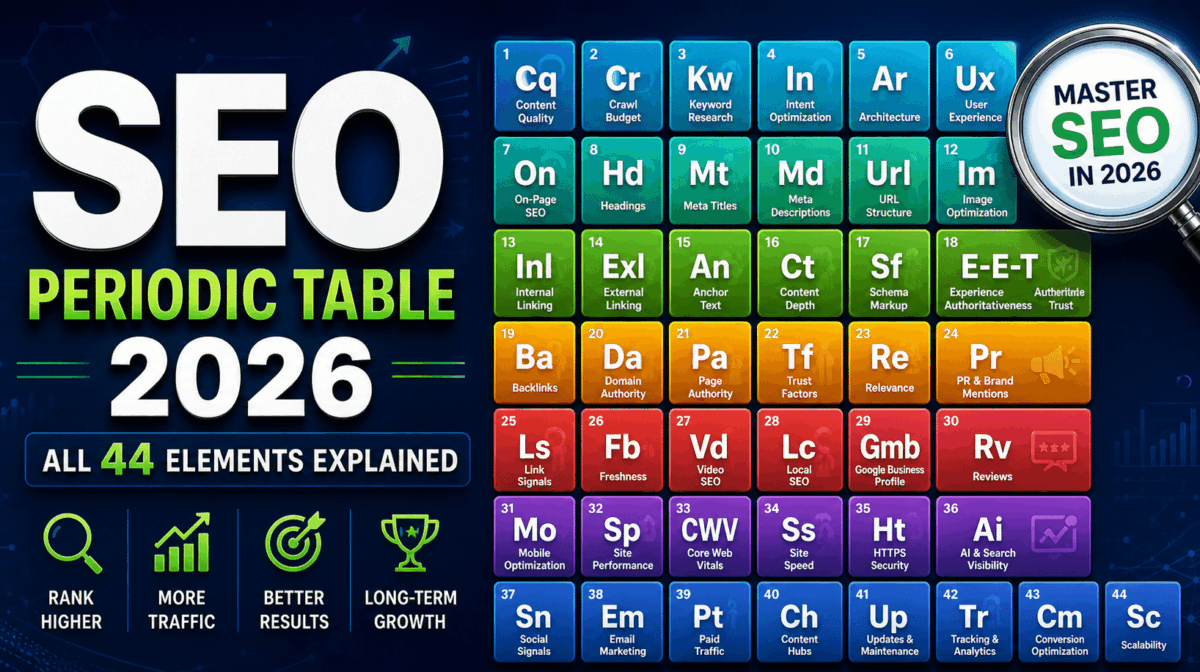
The SEO Periodic Table: All 44 Elements Explained
Every ranking factor organized, explained, and made actionable — with real implementation tips for each of the 44 SEO elements.
The SEO Periodic Table is the most widely referenced framework in search engine optimization. Originally created by Search Engine Land in 2011, it organizes the critical ranking factors into a memorable, scannable structure. In this guide, we go beyond the basic definitions — giving you actionable implementation tips for every single element across all 7 groups.
What Is the SEO Periodic Table?
The SEO Periodic Table is a framework that maps the most important search ranking factors onto a visual grid inspired by the chemistry periodic table. Each “element” represents a ranking signal or best practice. Elements are grouped by category so you can understand how different aspects of SEO connect.
Unlike a simple checklist, the periodic table metaphor conveys something important: these elements work together as a system. Just as chemical elements combine to form compounds, SEO elements combine to determine your overall ranking potential. Weakness in one group can undermine strength in others.
The SEO Periodic Table — All 44 Elements
Group 1: Content
Quality
High-quality content is helpful, accurate, well-written, and tailored to the specific audience — not just optimized for bots.
How to implement
- Research what competitors are missing and fill the gap
- Have a subject expert review or write the content
- Zero tolerance for grammatical errors — use Grammarly
- Aim for the “one definitive resource” mindset per topic
Keywords
The words and phrases your audience uses to find your content. Natural integration matters more than exact repetition.
How to implement
- Use tools like Ahrefs, Semrush, or Google Search Console
- Target long-tail keywords for faster wins
- Include keywords in: title, H1, first 100 words, subheadings
- Never stuff — use LSI (related) terms naturally
Freshness
Timely content and regular updates signal to Google that your site is actively maintained and relevant.
How to implement
- Set a content audit calendar (quarterly at minimum)
- Update publication dates when making substantial changes
- Remove or redirect pages with stagnant, declining traffic
- Add “Last updated” timestamps for trust signals
Relevance
Does your content fully satisfy the informational need of someone searching the target query? Relevance is about match, not just topic.
How to implement
- Read the top 10 SERPs for your target keyword — what do they all cover?
- Use People Also Ask and related searches sections
- Map content to the correct search intent (info, transactional, navigational)
Accuracy
Factually correct content that delivers on the promise of the headline. Clickbait signals high bounce rates and low satisfaction.
How to implement
- Cite sources from authoritative domains (gov, edu, journals)
- Fact-check statistics before publishing — use Statista, PubMed, etc.
- Make titles specific, not sensational
Depth
Comprehensive coverage of a topic — not word count for its own sake, but making sure no important sub-question is left unanswered.
How to implement
- Use content gap analysis to find subtopics competitors cover but you don’t
- Create a detailed outline first, then write to it
- Add FAQ sections targeting related long-tail queries
Uniqueness
Content that adds original value: unique research, first-person experience, proprietary data, or a genuinely fresh perspective.
How to implement
- Conduct original surveys or case studies
- Share your own data, experiments, or test results
- Take a contrarian stance where evidence supports it
Answers
Content structured to directly answer questions — essential for featured snippets and voice search dominance.
How to implement
- Target “how,” “what,” “why,” and “best” queries explicitly
- Format answers in 40–60 word concise paragraphs for snippets
- Use structured lists and tables for list-style featured snippets
Multimedia
Images, videos, infographics, and audio that enhance the content experience and create additional search entry points.
How to implement
- Embed original images (not stock) — screenshots, diagrams, charts
- Add YouTube videos to increase time-on-page
- Compress all images with WebP format for performance
Language
Writing in the language and dialect of your target audience — including regional spellings, idioms, and reading level.
How to implement
- Use hreflang tags for multi-language content
- Match regional spelling (color vs colour, organize vs organise)
- Match reading level to your audience (Flesch–Kincaid tool)
Consensus
Particularly critical in YMYL (Your Money, Your Life) verticals — your content should align with consensus from high-quality, authoritative sources.
How to implement
- Especially important for medical, legal, and financial content
- Cite peer-reviewed research, not blogs, for sensitive claims
- Avoid contrarian stances without solid evidence
Value
Every page should have a clear reason to exist — a distinct value proposition that serves a genuine user need.
How to implement
- Ask “why would someone bookmark this page?” before publishing
- Merge thin pages with similar ones to concentrate value
- Don’t publish just to fill a content calendar — quality > quantity
Group 2: Architecture
Crawlability
Search engine bots must be able to discover, access, and fully render all your important pages.
How to implement
- Submit XML sitemaps to Google Search Console
- Keep your robots.txt clean — don’t accidentally block key pages
- Fix crawl errors weekly via GSC Coverage report
- Avoid orphan pages with no internal links pointing to them
Taxonomy
The hierarchical structure of your site’s topics and subtopics — essential for topical authority and entity SEO.
How to implement
- Build topic clusters: one pillar page + multiple supporting posts
- Create clear category and subcategory structures
- Use breadcrumbs to reinforce hierarchy for users and bots
Page Structure
Clear separation between main content, supplemental content, and ads — making pages easy for both humans and algorithms to parse.
How to implement
- Use semantic HTML: <main>, <article>, <aside>, <nav>, <footer>
- Keep ads and sidebars from overwhelming main content above the fold
- Implement proper heading hierarchy (H1 → H2 → H3)
Mobile-first
Google indexes and ranks primarily from the mobile version of your site. Mobile UX is non-negotiable.
How to implement
- Use responsive design — test with Google’s Mobile-Friendly Test
- Ensure tap targets are ≥48px and well-spaced
- Eliminate intrusive interstitials on mobile
- Test Core Web Vitals specifically on mobile
URLs
Clean, descriptive, keyword-rich URLs improve both usability and crawlability.
How to implement
- Use hyphens not underscores: /seo-periodic-table not /seo_periodic_table
- Keep URLs short and descriptive — remove dates from blog post URLs
- Avoid parameters like ?id=123 for important pages
Canonicalize
Prevent duplicate content issues by specifying the authoritative version of each page.
How to implement
- Add canonical tags on all pages, even self-referencing ones
- Use 301 redirects to consolidate duplicate URL variants
- Canonicalize paginated pages back to the root collection page
Pagination
How you handle multi-page content — category archives, product listings, article series.
How to implement
- Use proper prev/next link relationships in <head>
- Consider “load more” patterns with proper URL management
- Ensure page 2+ can be discovered and indexed if valuable
HTTPS
SSL/TLS encryption is a Google ranking signal and essential for user trust, especially on forms and e-commerce.
How to implement
- Get a free SSL certificate via Let’s Encrypt or your host
- Force HTTPS redirects — all HTTP → HTTPS with 301
- Fix mixed content warnings (HTTP assets on HTTPS pages)
Group 3: Code
Title Tags
The clickable headline in SERPs. The most direct on-page ranking signal for page relevance.
How to implement
- Keep under 60 characters to avoid truncation
- Lead with the primary keyword, end with your brand
- Write for clicks, not just rankings — test different headlines
- Every page needs a unique title tag, no exceptions
Meta Descriptions
Not a direct ranking signal, but a critical click-through rate driver. Google shows these in search results ~50% of the time.
How to implement
- Write 150–160 characters of compelling copy
- Include the primary keyword (bolded in search results)
- Use a clear call to action: “Learn how to…”, “Discover…”
Headings
H1–H6 tags create hierarchy, improve accessibility, and signal topical structure to search engines.
How to implement
- Use one H1 per page — make it keyword-rich and descriptive
- Use H2s for major sections, H3s for subsections
- Many H2s appear as “jump to” links in Google search results
Image Alt Text
Text descriptions of images — required for accessibility and a key signal for image search ranking.
How to implement
- Describe what’s in the image accurately and specifically
- Include keywords naturally — but don’t stuff them
- Skip alt text on decorative images (use alt=””)
Schema Markup
Structured data (JSON-LD) that enables rich results: FAQs, ratings, recipes, events, products in SERPs.
How to implement
- Start with Article, FAQ, BreadcrumbList, and Organization schema
- Use Google’s Rich Results Test to validate your markup
- Add Product and Review schema for e-commerce pages
- HowTo schema can earn step-by-step rich results
Group 4: Credibility (E-E-A-T)
Trustworthiness
Demonstrated accuracy, honesty, and reliability over time across your entire site and brand.
How to implement
- Display author names, bios, and credentials on all articles
- Include About page, Contact page, and Privacy Policy
- Fix factual errors publicly and transparently
- Use HTTPS and display trust badges (especially e-commerce)
Experience
The “E” added to E-A-T in 2022. First-hand, lived experience with the topic. Reviews, case studies, and personal anecdotes.
How to implement
- Add “I tested this personally” language and evidence
- Include original photos proving you’ve done the thing
- Product reviews should be based on actual hands-on use
Expertise
Deep knowledge of a subject demonstrated through accurate, detailed, nuanced content that only an expert could write.
How to implement
- Hire experts or collaborate with them to produce or review content
- Display author credentials, certifications, and publication history
- Reference industry research and primary sources throughout
Authoritativeness
Recognition by others in your field — primarily via inbound links, mentions, and citations from authoritative sources.
How to implement
- Earn links from industry publications, news sites, and .edu/.gov domains
- Get brand mentions even without links — they still signal authority
- Speak at conferences, publish guest posts on authority sites
Brand
A consistent, recognizable identity that people actively seek out. Brand searches are a strong quality signal to Google.
How to implement
- Maintain consistent name, logo, and messaging across all channels
- Build social media presence — brand signals feed into authority
- Encourage branded searches: “amezingtech [topic]”
Creator
The background and credentials of individual content creators — education, certifications, peer recognition, publications.
How to implement
- Create detailed author bio pages with credentials
- Link author pages to their LinkedIn and professional profiles
- Use Schema.org Person markup to associate authors with articles
Group 5: Links
Inbound Links
Backlinks from trusted, relevant, high-authority external websites. The most powerful off-page ranking factor.
How to implement
- Create link-worthy “skyscraper” content — data studies, tools, guides
- Pursue digital PR: pitch journalists your original research
- Guest post on authoritative niche publications
- Reclaim unlinked brand mentions with outreach
Internal Links
Links between your own pages that distribute PageRank, improve crawlability, and guide users through your content.
How to implement
- Ensure every important page has at least 3–5 internal links pointing to it
- Link new content from older high-authority pages
- Use descriptive anchor text, not “click here”
- Build hub-and-spoke models with pillar content at the center
Anchor Text
The visible, clickable text of a hyperlink — signals topical relevance to both users and search engines.
How to implement
- Use descriptive, keyword-relevant anchor text for internal links
- Diversify external anchor text — over-optimized anchors are a red flag
- Avoid generic anchors: “click here,” “learn more,” “read this”
External Links
Links from your pages to reputable, authoritative external sources — signals that you’ve done proper research.
How to implement
- Link out to primary sources: studies, government sites, experts
- Use target=”_blank” with rel=”noopener” for external links
- Add nofollow only to paid or UGC links — not all external links
Group 6: User
Search Intent
The true underlying goal behind a search query — informational, navigational, commercial, or transactional.
How to implement
- Analyze the top 10 results to understand what format Google rewards
- Match content type to intent: blog post vs product page vs tool
- Don’t try to rank a product page for an informational keyword
Satisfaction
Fully meeting the user’s need so they don’t bounce back to SERPs (“pogo-sticking”) — a strong behavioral signal.
How to implement
- Answer the core question immediately — don’t bury the lede
- Include everything relevant so users don’t need another source
- Monitor bounce rate and time-on-page with GA4
Task Completion
Helping users accomplish their goal — especially for transactional and navigational searches, leading to conversion points.
How to implement
- Add clear CTAs that match what the user came to do
- Reduce friction in forms, checkout, and sign-up flows
- Use heatmaps (Hotjar) to see where users drop off
Accessibility
Ensuring your site works for all users — including those with visual, auditory, motor, and cognitive disabilities.
How to implement
- Meet WCAG 2.1 AA standards minimum
- Ensure keyboard navigability and screen reader compatibility
- Maintain 4.5:1 color contrast ratio for body text
- Add captions to videos, transcripts to audio
Locality
Location-specific content and signals that help you rank for local searches — “near me,” city, neighborhood queries.
How to implement
- Claim and optimize your Google Business Profile
- Create location-specific landing pages for each area you serve
- Acquire citations (NAP consistency) across local directories
Interactions
User behavior signals from SERPs: click-through rate, dwell time, scroll depth, and query refinements.
How to implement
- Optimize title tags and meta descriptions for click-through rate
- Improve dwell time with engaging intros — hook users in the first 3 sentences
- Monitor CTR trends in Google Search Console
Group 7: Performance
Speed (LCP)
Page load speed — specifically Largest Contentful Paint (LCP), which should be under 2.5 seconds.
How to implement
- Use a CDN (Cloudflare, BunnyCDN) to serve assets from nearby servers
- Enable lazy loading for below-the-fold images
- Use WebP/AVIF image formats and compress images aggressively
- Preload hero images and critical CSS/fonts
- Target: LCP <2.5s (Good), <4.0s (Needs Improvement)
Responsiveness (INP)
Interaction to Next Paint (INP) — how quickly the page responds to user inputs like clicks, taps, and keyboard events.
How to implement
- Break up long JavaScript tasks — use Chrome DevTools Performance panel
- Defer non-critical JS with async/defer attributes
- Use web workers for computationally heavy tasks
- Target: INP <200ms (Good)
Stickiness (CLS)
Visual stability (Cumulative Layout Shift — CLS) measures how much content unexpectedly shifts during load. Also includes general engagement that keeps users coming back.
How to implement
- Set explicit width and height attributes on all images and videos
- Reserve space for dynamic content (ads, embeds) with min-height CSS
- Avoid inserting content above existing content after load
- Target: CLS <0.1 (Good)
How to Prioritize: The SEO Priority Matrix
With 44 elements to address, where do you start? Use this impact-vs-effort matrix to build your SEO roadmap:
Quick Wins
HTTPS (H), Title Tags (Tt), Meta Descriptions (D), Alt Text (At), XML Sitemap (Crawl), Canonical Tags (Ca), Schema Markup (Sc)
Strategic Investments
Content Quality (Q), Inbound Links (Ib), E-E-A-T/Credibility, Page Speed (S), Taxonomy & Topic Clusters (Ta), Search Intent (It)
Maintenance Tasks
External Links (Ex), URL Structure (Ur), Pagination (P), Language matching (L), Headings refresh (Hd)
De-prioritize for Now
Local Citations (Ly) unless local business, Consensus (Cn) unless YMYL niche, Interactions optimization unless at scale
✅ Complete SEO Audit Checklist (All 44 Elements)
Check off each item as you audit your site. Click to mark complete.
Frequently Asked Questions
Ready to Apply These SEO Elements?
Get a free SEO audit of your website — see exactly which of the 44 elements are dragging your rankings down.
Get Your Free SEO Audit →